The most useful surprise in early American naval history is a matter of sequence: the Continental Navy's recognized founding date falls in 1775, before the Declaration of Independence in 1776. Anniversary graphics often place those years so close together that they become one general age of sails, flags, and rebellion. Yet the interval matters. People were making decisions about ships, money, command, and supply while the political future was still unsettled. A naval institution did not appear complete simply because a later generation could give its beginning a birthday.
For readers following the 250th-anniversary interest in American maritime heritage, the better question is therefore not merely when did the navy begin? It is what exactly began, who authorized it, and how did an authorization turn into an operating organization? Those questions lead away from a single heroic silhouette and toward a chain of practical decisions. They also make room for the mariners, shipbuilders, suppliers, legislators, and communities whose work disappears when the story is told only through one commander or one battle.
Start with the resolution rather than the anniversary slogan
The Naval History and Heritage Command's transcription of the October 13, 1775 resolution gives a specific starting point. Congress authorized a swift sailing vessel carrying ten carriage guns and a proportional number of swivel guns, with eighty men, for an initial three-month cruise. It also called for another vessel and for estimates and contracting arrangements. The proposed purpose included intercepting transports bringing military supplies to the opposing forces. These particulars reveal a limited task with immediate wartime priorities, not a complete blueprint for every naval responsibility that would follow.
Read that short document twice. On the first pass, underline the desired activity: cruising and intercepting supply transports. On the second, circle the work needed before that activity can occur: estimating expense, contracting, fitting out, and organizing people. The second set of words is less memorable than a cannon count but more revealing about institution building. The resolution made a decision possible; it did not itself purchase every item, recruit every sailor, or put every required skill aboard a finished vessel.
A birthday is a chosen historical anchor
The Navy's historical background on its birthday identifies October 13, 1775 as the origin of the Continental Navy and explains the later recognition of that date for annual commemoration. It also acknowledges the contributions of other places and activities to the beginnings of American naval operations. Those two ideas work well together. An institution can choose a coherent anniversary without requiring every important early action to have occurred on that day or in that one city.
For a museum label or family discussion, call the date an anchor rather than a shortcut. An anchor fixes a useful reference point while leaving room to examine the surrounding waters. The historical questions continue before and after it. What earlier pressures made the decision seem necessary? What happened when the instructions reached the people expected to carry them out? Which responsibilities shifted as the war developed? Anniversary language becomes stronger when it opens those questions instead of encouraging readers to imagine a finished national navy waiting behind a single congressional vote.
The Revolution had more than one maritime organization
A beginner can easily assume that every American vessel opposing Britain belonged to the same national fleet. That assumption can turn a complicated wartime maritime world into a misleading list. Nationally authorized vessels, locally organized defenses, state efforts, and privately owned vessels acting under wartime authority require careful identification. The relevant question is not whether their crews contributed to the struggle. It is who owned, commissioned, paid, commanded, and directed each vessel at a particular time. Those administrative details help explain differences that a painting of ships at sea may conceal.
The NHHC account of the Navy's birth presents institutional development as uneven and politically contested rather than immediate and automatic. Use that interpretation to resist turning a shared cause into a shared organization. When reading a ship biography, make separate notes for the vessel's name and its authority. If the author calls a craft American, check whether that describes geography, allegiance, ownership, or national naval service. The distinction can change the meaning of the entire account while leaving the crew's courage entirely intact.
A ship name is only the beginning of an identification
Historical vessel names can recur, spelling can vary, and later ships can inherit names from earlier ones. A search result containing the correct name is therefore a lead, not an identification. Build a simple research card with the name, approximate dates, vessel type, operating waters, and source used. Add a column for confidence: established by a contemporary record, reported by a later institutional summary, or still uncertain. This is particularly useful when matching an old image to a written account because an attractive caption can be repeated without its original evidential support.
Look for the smallest fact that will separate competing candidates. A construction date may rule out an image. A different home waters description may indicate a namesake. A later reconstruction may share a name and broad appearance while belonging to an entirely different material history. Rather than immediately asking whether a picture is authentic, ask which claim it is supposed to support. It might accurately show a modern interpretation of a historic design while being incapable of showing the original vessel's exact details or wartime condition.
The work of making a fleet belongs in the story
A gun count offers an easy comparison, but it is a thin description of what made a vessel useful. A ship also needed people who could handle it, supplies that could reach it, repair capacity, and instructions that matched its condition and purpose. Consider the founding resolution as a practical problem set. What had to be known before an estimate could be made? Which decisions could be changed quickly and which required time ashore? What would happen if the vessel was ready before the people or equipment expected to sail in it?
These questions are analytical prompts, not an attempt to invent a particular incident. Their value is that they make readers aware of the kinds of records historians need. An instruction describes intention. A contract describes an agreement. An account may describe expenditure. A report may describe an outcome. Each can illuminate one part of the process without representing all of it. Someone who learns to distinguish those records is better equipped to understand both a small eighteenth-century naval project and the ambitions described on a modern historical ship website.
Chronology shows development without making it inevitable
The NHHC chronology of Congress and the Continental Navy records further decisions after the October 13 resolution, including additional vessels later that October and the organization of a Marine Corps in November. The sequence shows that the initial authorization was followed by more institutional work. It should not be read as proof that every later development was already settled in the first decision. A chronology is most useful when it preserves the uncertainty between one entry and the next.
Make a three-column version of that timeline: decision, practical implication, and unresolved question. A decision to add vessels raises questions about procurement and staffing. A decision concerning authority raises questions about how instructions were transmitted and interpreted. Separating the columns prevents a timeline from becoming a march of inevitable progress. It also creates a more honest narrative for a young reader. People in the past had incomplete information and competing priorities; knowing the eventual outcome does not mean they could see it as clearly as a modern anniversary poster suggests.
Scale should be compared with care
The Navy's American Revolution overview emphasizes the disparity between the emerging American forces and the much larger Royal Navy. That broad imbalance helps explain why an account of naval history should ask about goals rather than judge every action as an attempt to defeat an entire opposing fleet. A limited cruise, a search for supplies, and an action connected to a particular locality can have different measures of success. The scale of the whole war and the purpose of one mission are related but not interchangeable.
A sensible reading exercise is to identify the aim before reading the outcome. If a ship was sent to intercept supplies, ask what evidence would show whether that happened. If an operation aimed to delay an opponent, ask how the chronology is established. Avoid assigning modern performance measures to a situation without first checking what the participants were ordered to do and what resources they had. This does not require excusing failure or turning every setback into a secret victory. It simply makes the assessment answer the historical question actually being asked.
Constitution belongs to a later chapter
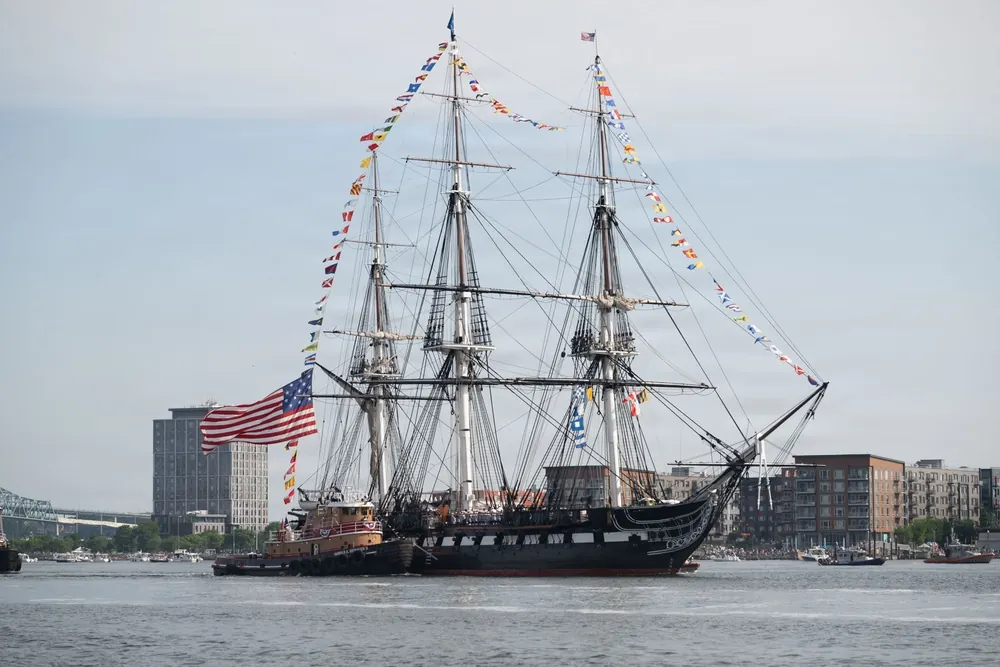
The hero photograph shows Constitution in Boston in 2026, a compelling image of American naval heritage. It is deliberately labeled as a later comparison. The National Park Service dates the ship's launch to 1797 and places her among the original frigates built for the United States Navy in the 1790s. She cannot serve as a surviving example of a vessel commissioned under the first 1775 authorization. Treating her as though she could would erase the very institutional change that makes the period worth studying.
Instead, put two dates beside the picture: the moment being commemorated and the date of the vessel shown. That simple habit helps a reader enjoy a heritage photograph without making it carry an impossible claim. It also opens a useful comparison between an emergency wartime beginning and the later naval choices of a federal republic. The comparison does not need to become a full technical history to be valuable. Recognizing that a powerful symbol can represent continuity without being a physical survivor of every stage is already a considerable improvement in historical understanding.
Material evidence can make the abstract questions tangible
The Smithsonian's Philadelphia preservation project describes a gunboat built in 1776, sunk during the Revolutionary War, raised in 1935, and now the subject of a multiyear conservation effort. This is a different form of encounter with the past from viewing a working ship in a harbor. A surviving hull can reveal aspects of construction and damage while requiring careful conservation and interpretation. Its present condition, exhibition history, and the limits of surviving material all form part of the evidence.
Do not ask one artifact to answer every question. Timber may support one kind of investigation; an order or account may support another. A model can help explain a proposed arrangement but should not be mistaken for recovered fabric. A historical reconstruction can demonstrate relationships of scale while reflecting modern decisions. Comparing those evidence types is a useful family or classroom activity because it replaces the vague distinction between real and fake with a sharper question: what can this particular object reliably help us understand?
A better anniversary question is what changed
The familiar date remains worth remembering. It provides a shared point from which to begin a more demanding conversation about authority, money, labor, seafaring experience, and the practical organization of a national cause. The story becomes more interesting when the resolution is seen as a task handed to real people instead of a ceremonial instant that solved every problem. A short document can mark a profound change while leaving an enormous amount of work still to be done.
For an America250 reading list, choose a founding document, a later institutional summary, and one well-documented vessel or artifact. Keep their dates and purposes visible. Ask where they agree, where they answer different questions, and where the evidence stops. That method creates a route into naval history that does not depend on memorizing an entire fleet. It starts with a specific decision, follows its practical consequences, and gives the reader a reason to keep asking how an idea became an organization capable of acting on the water.