The striking question about Eagle is not why people enjoy seeing her. A three-masted vessel under sail answers that almost immediately. The more interesting question is why an organization that operates modern cutters and aircraft continues to train future officers aboard a ship built in 1936. The answer begins with the difference between possessing technical information and being responsible for a task that other people must carry out together. A sailing ship makes that relationship visible: a decision, a spoken instruction, a group response, and a result that has to be observed.
The Coast Guard Academy identifies training as Eagle's primary mission, serving cadets and officer candidates while teaching seamanship, navigation, leadership, and teamwork. This is the institution's own explanation, not an independent evaluation of every training outcome. It does establish that the vessel has a present educational purpose. The ship's historic appearance is part of the public encounter, but it does not fully explain the work required to keep her in service or the reason trainees spend time aboard.
Begin with the ship's present job
A useful introduction should keep three things separate: the age of the vessel, the historical significance of its earlier service, and the purpose of its current program. Eagle can be discussed in all three ways, but they answer different questions. An old construction date does not automatically make a ship a passive exhibit. A present training role does not erase the history of how she came to the United States. Combining those layers carefully produces a richer understanding than treating the ship as either a floating photograph or a timeless classroom.
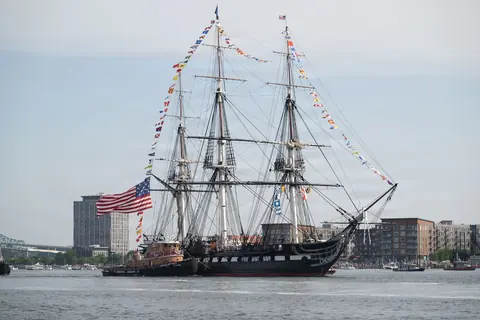
For readers encountering the vessel through the 2026 tall-ship gatherings, a dated Coast Guard photograph from Boston provides a specific public moment: Eagle participating in the July 11 Parade of Sail. That record identifies a place, date, photographer, and training role. It does not show the whole training program. Starting with the caption and then following the operator's mission information is a more reliable route into the subject than treating one dramatic scene as a complete account of life aboard.
Why a shared physical task can teach responsibility
Consider an ordinary group-learning problem: several people understand an instruction individually but have to act together. Knowledge alone will not settle timing, coordination, or whether everyone understood the same words. A sailing environment can make those gaps immediately noticeable because people are working with an actual vessel and changing surroundings. This is an editorial explanation of why such a setting can support learning, rather than a claim that this desk watched a particular exercise aboard Eagle. The distinction matters when an article discusses experience without possessing firsthand observation.
The educational interest is not simply that the task is difficult. A difficult activity can confuse or exclude people if it has no clear progression. The useful questions are how a task is introduced, what preparation precedes it, how responsibility is supervised, and how the result is discussed. A prospective researcher should ask about those mechanisms before describing a voyage as transformative. The visible effort of handling sails may create a powerful impression, yet an account of learning becomes more convincing when it explains the relationship between effort, feedback, and a defined educational aim.
Navigation connects observation with judgment
Navigation is easy to reduce to an instrument or a line on a screen. As a subject for learning, it also raises questions about what is known, how recently it was observed, and what should be checked before acting. The reader does not need instructions for operating a vessel to appreciate that distinction. Imagine a classroom exercise in which two pieces of information disagree. A good response requires identifying their sources, considering their limitations, and deciding what further observation would help. Those habits are useful well beyond the setting of a tall ship.
The Academy's published mission includes navigation and ship handling, but a general visitor page cannot establish exactly how every voyage is taught. Avoid filling that gap with an invented lesson plan. Instead, use the mission statement to frame a more focused question for an authorized educational contact: how are observations discussed, how is uncertainty represented, and how do trainees learn when to ask for assistance? Questions of that kind reveal more about professional judgment than simply asking whether trainees use old or modern equipment. Different tools can support related habits of careful observation.
A barque has a design, not just a silhouette
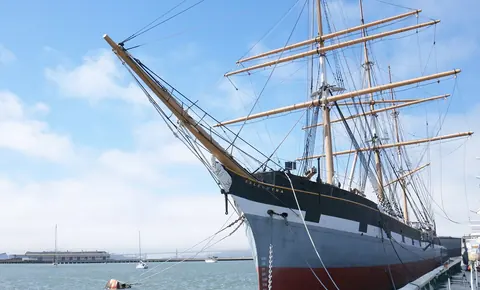
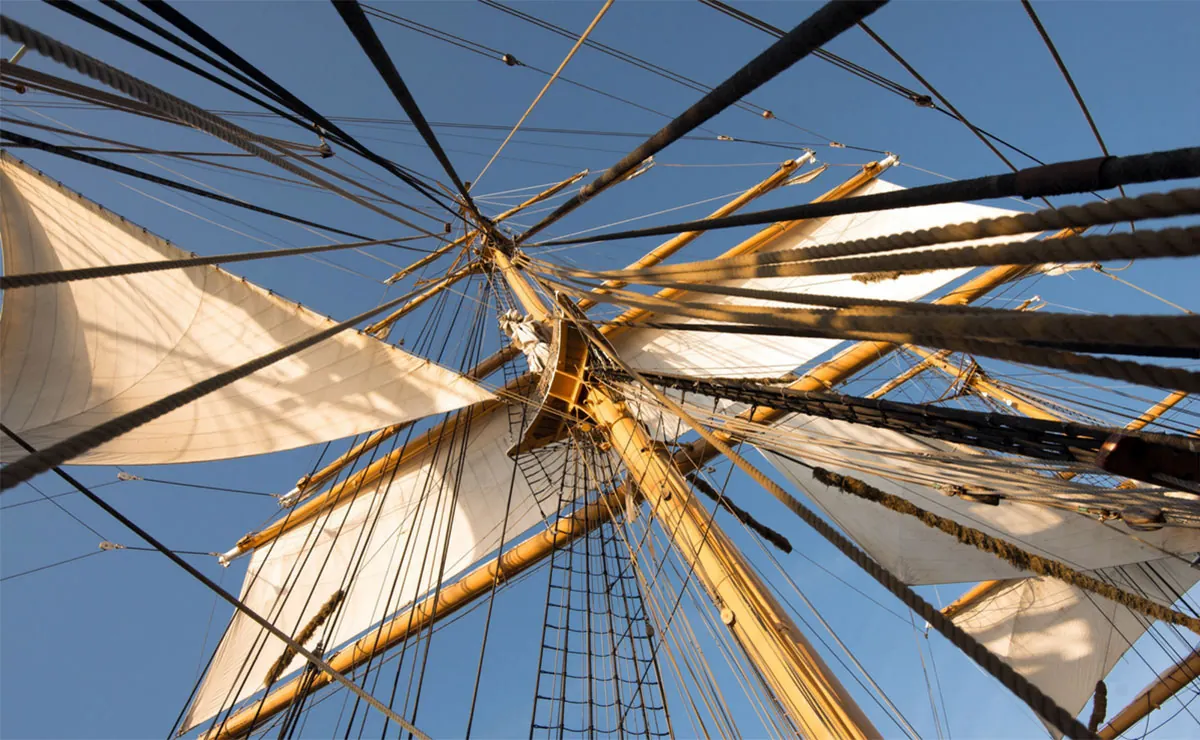
The Academy's vessel page describes Eagle as a 295-foot, three-masted barque. Its fact list includes 23 sails, a tallest mast of 150 feet, and approximately six miles of rigging. Those figures help a beginner appreciate the scale of the platform, provided they remain attached to the source and measurement conventions. They are not a promise that every published technical record will use identical figures for sail area, displacement, complement, or every aspect of the ship's changing equipment.
The first learning exercise can be entirely shore based. Sketch the masts and the broad arrangement of the rig from a clearly identified photograph, noting parts that are obscured. Then compare the sketch with an operator's description. The purpose is to connect a technical term with evidence instead of memorizing a label in isolation. A drawing can also make uncertainty obvious: if a sail is not set, do not invent its shape; if the framing cuts off a feature, mark the edge rather than completing it from imagination. Accuracy begins with knowing what can be seen.
The permanent crew makes the teaching possible
A public photograph often draws attention to trainees aloft or visitors on deck. A training institution also relies on continuity between voyages. The Government Accountability Office's 2025 cutter report describes Eagle's permanent crew as maintaining the ship year-round, alongside her role in providing at-sea experience. The report places the vessel in a broader discussion of Coast Guard maintenance and workforce challenges. It is a useful reminder that a learning environment is supported by people whose expertise continues when the most visible public event has ended.
For public-history writing, this changes the emphasis from individual daring to organized capability. Who prepares equipment for a training period? How does knowledge move from experienced crew members to newcomers? How are recurring tasks documented so that the next group can learn without starting from nothing? These are research questions, not an attempt to specify Eagle's internal procedures. They help a visitor appreciate that education at sea depends on dependable routines and skilled support as well as memorable moments. The people maintaining the classroom are part of the educational story.
The history needs direct language
The Coast Guard Historian's record identifies Eagle's construction at Blohm and Voss in Hamburg in 1936 as Horst Wessel and her commissioning into the Coast Guard in 1946. Her origin as a German naval training vessel belongs in any responsible account. The later American training mission is another chapter in the same ship's biography. There is no educational benefit in allowing attractive present-day imagery to make the earlier political context disappear.
A clear interpretation can acknowledge that history without turning a short visitor guide into a complete account of twentieth-century Europe. State the documented sequence, link the reader to fuller institutional records, and distinguish the vessel's changing names, ownership, and service. The underlying skill resembles the one needed for any complex artifact: an object can survive through very different uses and meanings. Understanding the transitions is more informative than assuming that its present symbolic role describes everything it has ever represented. The physical continuity of a ship does not mean its institutional meaning has remained constant.
Why technical numbers sometimes disagree
The Historic American Engineering Record documentation for Eagle explicitly cautions that draft, displacement, and tonnage can vary with time and measurement. This makes the record useful for more than collecting dimensions. It demonstrates why a figure should retain its label, date, and source. Overall length and waterline length are different measures; a number stripped from its heading can become an apparent contradiction when it is really answering a different technical question.
A reader building a comparison chart should therefore copy the measure before copying its value. Include the unit, the publication date if supplied, and any qualification about condition. If two sources differ, record both rather than choosing whichever produces the more dramatic sentence. Resolving the difference may require information unavailable in a general article. Acknowledging that limit is a mark of careful research. It also makes technical reading less intimidating for beginners, because the problem may lie in changing definitions or documentation rather than a failure to understand the ship.
Public access and professional training are distinct activities
Eagle also has a public-facing role. A Coast Guard media advisory issued in August 2026 described a specific return to New London and a limited media opportunity. It is evidence of that dated activity, not a standing invitation for readers to repeat it. Historical advisories frequently remain searchable, so the publication date is part of their meaning. Practical access must be checked through current official information rather than inferred from an old announcement or a photograph showing an open gangway.
Likewise, an authorized public visit is not equivalent to participating in a training voyage. A visitor may see selected spaces and hear an introduction while the crew protects working areas and operational priorities. That does not make the visit superficial; it simply gives it a different purpose. A thoughtful question asked during a short encounter can lead to more learning afterward. Readers interested in current tours should use the responsible operator's updated channels. Readers interested in the educational system should look for mission descriptions, historical documentation, and evidence appropriate to that particular question.
How to read claims about confidence and teamwork
Descriptions of sail training often use appealing words such as confidence, leadership, and resilience. Those terms need enough explanation to be useful. Confidence in what task, demonstrated under which conditions, and assessed by whom? Teamwork during one well-supervised activity may show progress without proving every participant will respond identically elsewhere. The Academy's rationale explains why it uses Eagle; it should not be expanded into a universal guarantee about the effects of every sail-training program or every person who sets foot on a tall ship.
A reader can apply a simple evidence test. Identify the claimed outcome, ask how it was observed, and check whether an account distinguishes participant impressions from independently measured results. Personal testimony can be valuable when it is clearly attributed, but it is not automatically a controlled comparison. This article offers no invented cadet testimony and no numerical claim of educational effectiveness. Its contribution is to explain the questions that make such claims more understandable. That approach respects both the people doing the training and the reader who deserves to know the limits of the evidence.
The older platform asks modern questions
It would be easy to tell Eagle's story as an argument that the past was harder and therefore taught better lessons. The more productive reading is that a particular environment can make important relationships easier to notice. Information has to become action. Individual skill has to fit a shared task. Decisions have to be checked against changing conditions. Those are modern responsibilities even when some of the equipment that makes them visible has a long history. The educational question concerns how the setting is used, not whether age itself is a virtue.
Eagle remains compelling because the ship lets a visitor ask about history and current professional learning in the same encounter. The answer deserves more than an attractive photograph or a broad promise of character building. Follow the present mission, name the working support behind it, keep the historical chronology intact, and treat precise claims with the evidence they require. A reader can leave the subject with a stronger appreciation of the vessel and a better way to assess any story about learning through demanding work. That is a worthwhile lesson even before the next set of sails appears on the horizon.