Flying Cloud’s best-known number is small enough to fit in a headline and large enough to describe an extraordinary journey: roughly eighty-nine days from New York to San Francisco by way of Cape Horn. The temptation is to imagine a ship moving at a spectacular speed continuously, driven by a heroic captain through one uninterrupted adventure. The more interesting explanation is less simple. A passage record combines the vessel’s capabilities, navigation, work aboard, changing weather, geographical decisions and the rules used to start and stop the clock.
That distinction matters whenever sailing photographs return to public attention. The 2026 interest in tall ships makes it easy to compare dramatic sail plans while overlooking what a historical record actually measures. Flying Cloud belongs to the world of commercial passage-making. Its achievement is best understood as a sustained result over a route, rather than a single burst of speed. Once that is clear, the famous number becomes a doorway into navigation and maritime labor instead of an isolated piece of trivia.
Two passages that should not be confused
The Smithsonian’s Time and Navigation account distinguishes an 1851 passage of 89 days and 21 hours from the improved 1854 passage of 89 days and 8 hours. Those figures are close enough that a casual summary can accidentally merge them. Preserving the two dates is essential: an improvement can be meaningful even when the total still rounds to eighty-nine days. Rounding is useful for conversation, but it should not erase the relationship between the original achievement and the later one.
Think of the rounded figure as an introduction and the fuller figure as a reference. A title does not need every hour to convey the subject. A historical explanation does need to identify which voyage it discusses. The same applies to route endpoints. “Around Cape Horn” explains the broad geographical challenge, but a serious record comparison also needs the actual timing convention. A result measured from one anchorage cannot automatically be treated as identical to one measured between different departure and arrival marks.
A passage record is not a maximum speed
Maximum speed describes a brief performance under particular conditions. Passage time describes how long the entire journey took, including slow periods. A vessel that briefly moves faster can still arrive later if it spends more time becalmed or chooses a less favorable route. The distinction is familiar on land: an occasional fast stretch does not determine the total duration of a long trip. At sea, the same arithmetic interacts with a moving environment rather than a fixed road.
Consider a deliberately simplified example, not a Flying Cloud log entry. If a hypothetical ship covered 240 nautical miles in a day, its average over that day would be ten knots. It might have sailed faster during one watch and slower during another. A recorded peak above ten knots would not contradict the daily average. Likewise, multiplying a reported peak by the length of an ocean passage does not reconstruct distance traveled. The exercise explains why spectacular speed claims need context before they become useful historical evidence.
Navigation deserves a place beside ship design
The National Park Service’s account of Eleanor Creesy identifies her as Flying Cloud’s navigator and connects the voyages with the use of Matthew Fontaine Maury’s wind and current information. It also distinguishes the 1851 and 1854 passage times. That gives the story an important second center of attention. The ship was a physical machine, but selecting and evaluating a route was intellectual work. A fast hull still had to be directed through an environment that no one could control.
Route choice is not simply a matter of drawing the shortest line between two ports. A longer track can produce a shorter elapsed time if it offers more useful winds or avoids an unfavorable area. This is an explanatory principle, not a claim that we have recreated every decision made aboard Flying Cloud. A complete reconstruction would require the log, dated positions and a careful treatment of available weather evidence. Without those, the responsible conclusion is that navigation mattered, rather than an invented account of exactly why every course alteration succeeded.
The crew is part of the performance
A sailing ship does not convert wind into passage time without people maintaining and handling the system. Canvas has to be managed, equipment inspected, steering maintained and information passed between those responsible for decisions and those carrying them out. It is reasonable to discuss these as parts of any sustained sailing operation. It is not reasonable to attach a precise number of minutes saved to an individual maneuver without evidence. Maritime history becomes less credible when admiration turns ordinary operational necessities into unsupported dramatic scenes.
One useful way to read a record story is to look for work that its headline leaves out. Who maintained the equipment between demanding periods? How were observations recorded? What had to remain functional for weeks rather than minutes? These questions do not diminish the achievement. They make it more substantial by replacing the image of a lone person producing a result with a vessel and crew maintaining a complex operation. If a source does not answer a question, keep it as a research question rather than filling the gap with an attractive guess.
Why a merchant ship’s arrival time mattered
Commercial sailing linked the physical journey with the value of what could be delivered at its end. The relevant question was not merely whether a ship looked impressive, but whether it could make a useful voyage with cargo and people aboard. Speed could influence the timing of delivery and the reputation of a vessel. Yet a record by itself does not prove that every voyage was profitable, that every cargo earned the same return, or that the most extreme design was always the best commercial choice.
The Metropolitan Museum of Art’s interpretation of an 1852 Flying Cloud print explains how remarkable passages also became publicity for builders, owners and captains. This offers a bridge between historical commerce and the way record stories circulate today. A striking image and a memorable number help a story travel. Readers should enjoy that publicity while recognizing its purpose. A celebratory print can document how a ship was promoted without independently proving each technical detail shown in the artwork.
Pictures reveal what people wanted to remember
Historical paintings and prints often emphasize a ship under an extensive spread of sail, with an attractive sea and a clear view of its rig. Such an image can be an important cultural object while still requiring interpretation. Ask who made it, when it appeared, what medium it uses and whether it was produced to celebrate a particular event. The answers determine the kinds of questions the image can support. Art can tell us a great deal about reputation without functioning as a measured naval-architecture drawing.
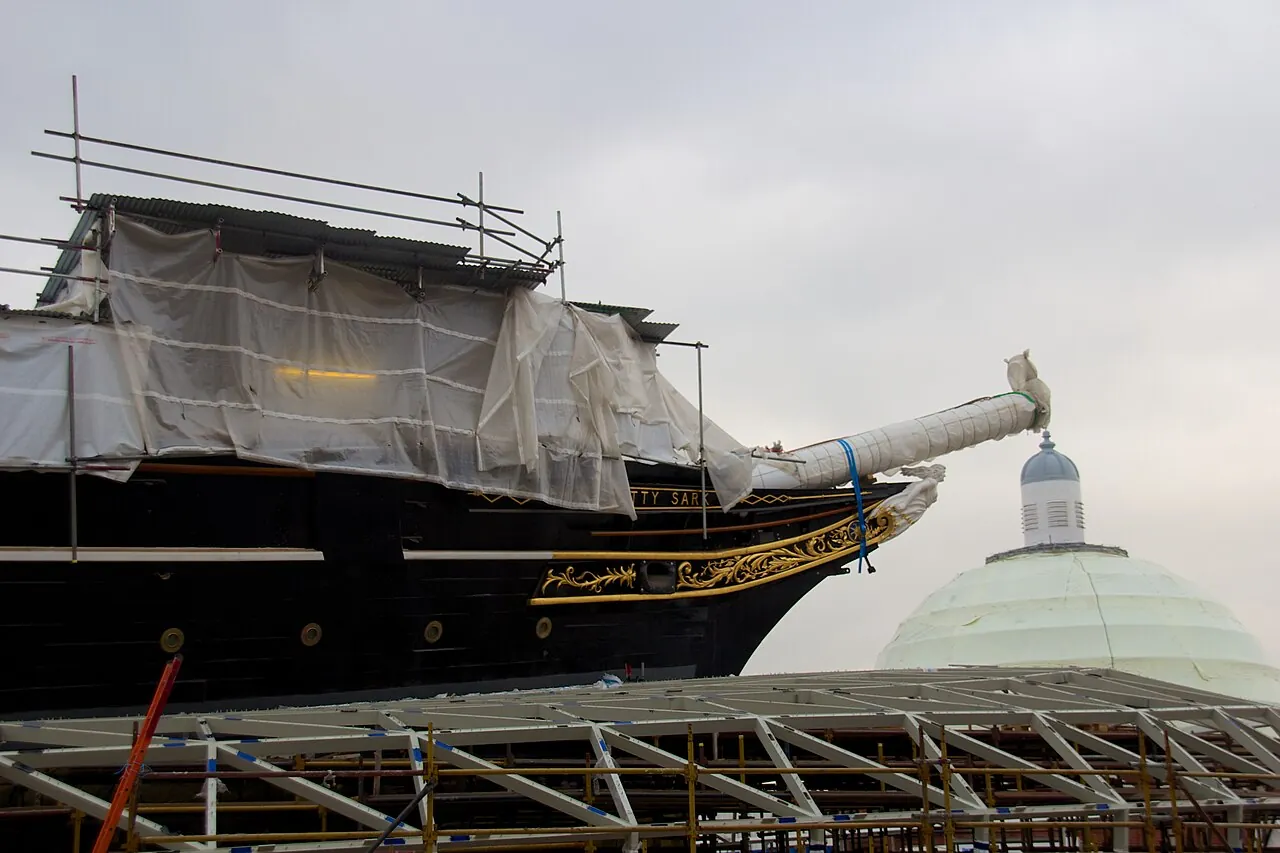
The photograph above this article shows the surviving clipper Cutty Sark at Greenwich, not Flying Cloud. That distinction is explicit because similarity of type should never become a false identification. The image gives a modern viewer a tangible comparison for the scale and complexity of a clipper’s rig. It does not show the vessel that made the New York–San Francisco record. Comparative imagery is useful when its role is clear; it becomes misleading when the caption silently lets one ship impersonate another.
Compare clippers without manufacturing a race
The Royal Museums Greenwich facts pack gives Cutty Sark’s maximum recorded speed as seventeen and a half knots. That number describes a different vessel and a different kind of measurement from Flying Cloud’s elapsed passage time. Putting the figures beside each other is a useful lesson in reading evidence, but it does not establish which vessel would win an imaginary race. A fair performance comparison would need matched conditions, routes, loading and the same definition of success.
Dates matter as much as measurements. Different ships worked in different trades and technical circumstances. Treating every famous clipper as an entrant in one timeless competition removes precisely the context that makes its design interesting. Instead, ask what each was built to accomplish and what evidence survives about the result. That approach allows admiration without a league table assembled from incompatible figures. It also makes room for less celebrated ships whose reliable work may be more representative of a trade than a single exceptional passage.
Read museum records critically
A museum catalogue is often the best starting point because it identifies an object, collection and supporting description. It is still worth reading carefully. A model, print and original document are different forms of evidence. The Mystic Seaport plans catalogue, for example, establishes a research trail for Flying Cloud material rather than automatically proving every feature of the original vessel. The existence of a plan in an archive is a reason to investigate its date and origin, not a guarantee that it was a builder’s working drawing.
The Mariners’ Museum collection description provides another route into the record’s history. Comparing institutional descriptions helps identify which details are consistently supported and which need more work. If later ownership or a precise incidental date is not necessary to explain the record and the evidence is inconsistent, omission can be the most accurate editorial choice. Completeness is not achieved by repeating every available detail; it is achieved by making the scope and quality of the evidence understandable.
What the record can still teach
Flying Cloud’s passage remains compelling because its essential question is recognizable: how does a team turn information, equipment and sustained effort into an exceptional result? The answer cannot be reduced to a hull shape, a lucky wind or one person’s confidence. The route and the clock connect all those elements. Reading the record this way also highlights work that heroic shorthand tends to obscure, particularly navigation and the continued labor required to keep a vessel performing over an ocean journey.
For a reader beginning maritime research, the next step is straightforward. Keep the 1851 and 1854 passages separate, identify the route, distinguish elapsed time from peak speed and verify the kind of source behind each illustration or claim. Then ask a question that the sources might actually answer. That method turns a famous eighty-nine-day headline into a usable historical investigation. The achievement does not need exaggeration to be remarkable; understanding what it measured makes it more impressive.