A waterfront photograph can contain two vessels of similar length, each with a forest of ropes and several tall masts, yet show two very different solutions to moving cargo and people under sail. One spreads square sails across horizontal yards. Another carries most of its canvas along the length of the hull. A third mixes the two. Calling all of them tall ships is convenient, but identifying their rigs reveals a more useful story: how builders and crews balanced wind, work, purpose and the equipment available to them.
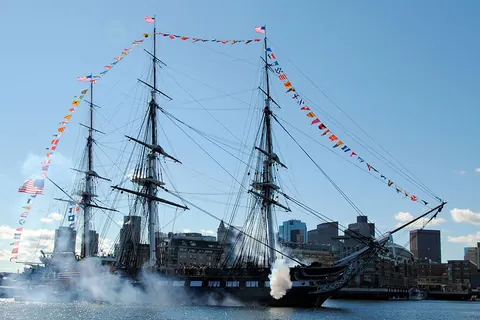
The photographs surrounding the 2026 Sail250 celebrations offer an excellent starting point for that exercise. Sail Boston’s description of the international gathering places the fleet within the United States’ 250th anniversary. That event context explains why so many people encountered traditional vessels together. It does not mean every ship in the fleet shared an age, construction method or mission. Reading the rig helps separate those questions, and gives a visitor something concrete to investigate after the excitement of the parade has passed.
Begin with the direction of the sails
The most useful first distinction is between square rig and fore-and-aft rig. A square sail is associated with a yard crossing the vessel; a fore-and-aft sail is arranged predominantly along its length. The terminology concerns the sail’s arrangement, rather than a promise that every piece of canvas is a perfect square. NOAA’s educational sheet illustrates the contrast and several combinations. Once that distinction is clear, a complicated silhouette begins to resolve into a readable pattern instead of a random accumulation of ropes.
Try this as an observation exercise from a permitted public viewing position. Find the bow, then trace the hull toward the stern. Look above it for a mast with yards crossing from side to side. Next look for long spars and sails arranged behind a mast along the vessel’s centerline. Do not start by counting ropes: a small number of large structural clues is more reliable. If sails are furled, the yards and booms can still provide evidence, but record uncertainty whenever an angle or another vessel obscures the view.
Count masts, then ask what each carries
Mast count narrows the possibilities, but does not finish the identification. A two-masted vessel might be a brig, brigantine or schooner. Three masts might belong to a full-rigged ship, barque or schooner. Additional distinctions depend on the distribution of square and fore-and-aft sails. The method is therefore a sequence: count, inspect, compare and check the vessel’s own description. Skipping the inspection step is how a confident identification based on a distant photograph becomes a confidently repeated mistake.
The order of masts matters too. A description that mentions the foremast is referring to the forward mast; the mainmast and, where present, the mizzen help locate the rest of the rig. Avoid assuming that whichever mast looks tallest in a photograph must be the one you need. Perspective can distort height. A side view is often easier to read than a dramatic photograph from beneath the bow, because the side view preserves the relationship between masts, yards and deck.
What makes a brig different
In the straightforward educational classification, a brig has two masts carrying square sails. That does not prevent it from also carrying headsails or an aft fore-and-aft sail. Classification depends on the defining rig, not on the absence of every other kind of canvas. A brigantine mixes square rig forward with a different arrangement aft. The Nova Scotia Museum’s sailing-rig reference is a useful cross-check when the visual pattern becomes more complicated or a historical author uses unfamiliar terminology.
Imagine comparing two photographs of the same two-masted vessel, one with all available sails spread and another at its berth with canvas bundled away. The first gives the shape of the working sail plan; the second may reveal the supporting spars more clearly. Neither photograph alone tells you how many people were required for a particular maneuver. That question depends on the actual equipment, operating practice and conditions. Treat the word brig as a description of arrangement, rather than a complete technical specification.
A barque changes the pattern aft
A familiar three-masted barque carries square sails on the forward and main masts and fore-and-aft sails on the aftermost mast. A full-rigged ship carries square rig on all its masts. Those patterns make the stern end especially valuable for identification. A vessel can look overwhelmingly square-rigged when viewed from the bow while its aft mast supplies the clue that separates one category from another. The final mast is often where a patient observer learns more than someone counting the most conspicuous sails.
This is also why a single mast hidden behind a neighboring vessel should make you cautious. If the aft rig cannot be seen, a photograph may support a broad identification without supporting a precise one. Writing “three-masted sailing vessel; aft rig obscured” is better than inventing certainty. Historians routinely work with incomplete evidence. Practicing that small habit at the waterfront makes it easier to understand why an archive caption, builder’s drawing and later illustration may not all settle a question in exactly the same way.
The schooner is more than a smaller tall ship
A schooner is principally fore-and-aft rigged and has two or more masts, although particular historical versions can carry square topsails. That exception is worth remembering: the presence of one square sail does not automatically turn every vessel into a brig or ship. The overall arrangement matters. Read the complete pattern before choosing a label, then compare it with the operator’s terminology. A museum interpretation may explain a regional variant that a simplified identification chart leaves out.
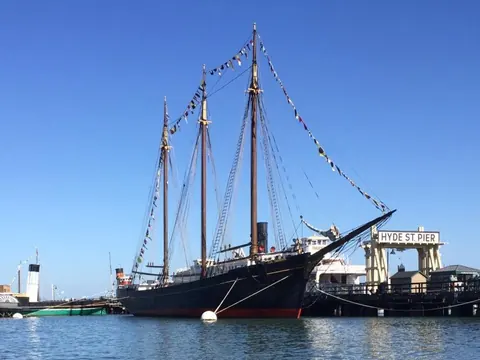
The National Park Service identifies C. A. Thayer as a lumber schooner built in 1895. That creates an important interpretive opportunity. Instead of treating its rig merely as a picturesque outline, connect it with the vessel’s commercial job. Ask how the deck was used, how cargo moved aboard, and how the sails related to the working space. You do not have to calculate performance to recognize that a ship’s appearance grew from practical demands rather than decoration alone.
Rig and hull tell different parts of the story
Rig identifies an arrangement above the deck; it does not by itself tell you what the hull is made from. Nor does the rig establish the vessel’s original nationality, the age of every component or its present use. A square-rigged ship might be a surviving cargo carrier, a later reconstruction or a contemporary training platform. Keeping those categories separate prevents a common museum misunderstanding: assuming that a convincing traditional appearance makes everything aboard an unchanged survival from the distant past.
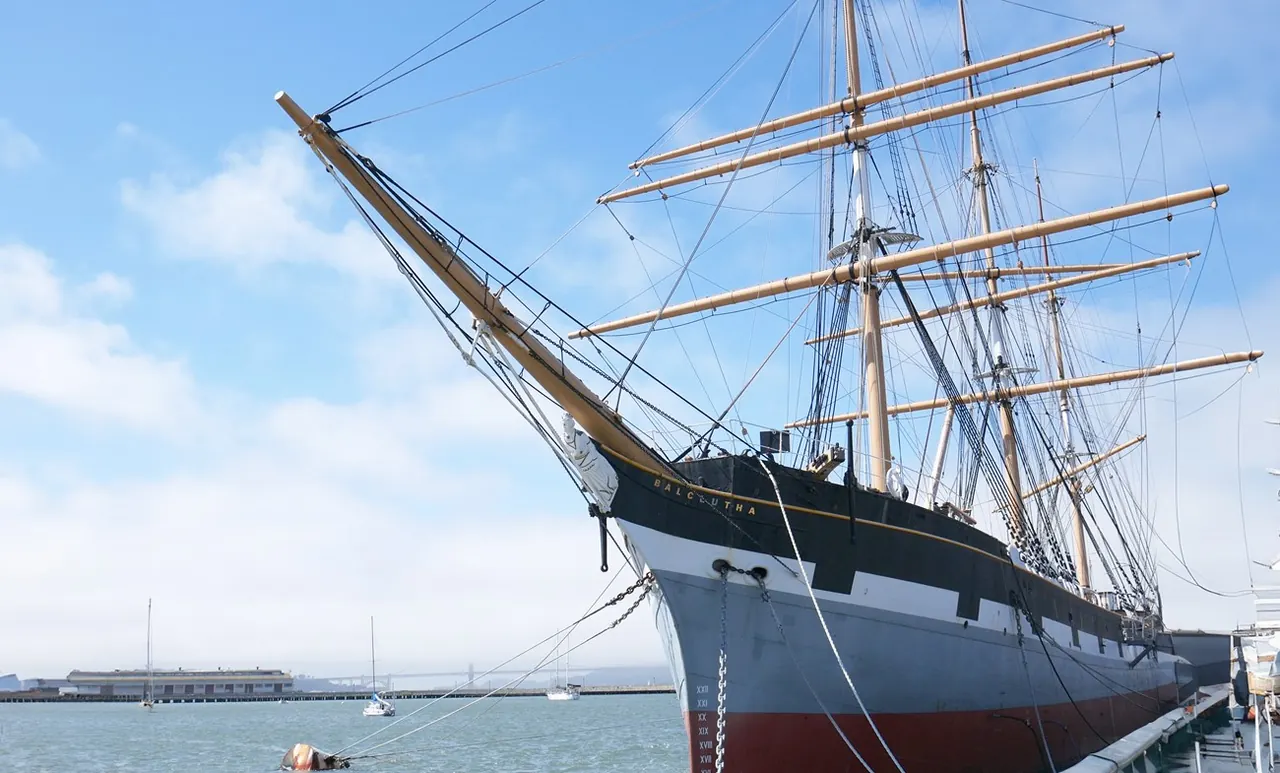
Balclutha provides a documented example. The National Park Service describes a three-masted square-rigged cargo ship built near Glasgow in 1886, using industrial hull materials alongside wind propulsion. That short description already combines several independent facts: date, construction, rig and purpose. It shows why a label such as old wooden sailing ship would be inadequate. The image accompanying this article is Balclutha, allowing readers to compare the visible arrangement with the collection description rather than treating the photograph as evidence for an unidentified vessel.
What the ropes can tell a patient visitor
Once you understand the larger structure, look for two broad jobs performed by rigging. Some lines support the masts and help maintain the structure. Others adjust sails and spars during operation. You do not need to identify every line to see that a traditional rig is a working system. Following one line visually from a belaying position toward a block or spar can turn what first looked like clutter into a connection between a human action and something moving high above the deck.
This should remain an observation exercise unless a qualified crew member explicitly includes you in an activity. Do not test a line to find out what it does. A coiled rope may be part of a prepared operation, and equipment that looks idle can still be serving a purpose. From a visitor’s perspective, the productive question is not “Can I pull this?” but “What would change if the crew adjusted this?” That question invites an explanation while respecting the ship as a workplace.
Use a photograph as a question, not a certificate
A dramatic image is excellent evidence of what the camera recorded at one moment. It is poor evidence for many other claims. A vessel photographed under a large spread of canvas has not thereby demonstrated its maximum safe sail plan, a particular speed or its behavior in a different sea state. Likewise, a photograph taken at a festival does not establish that the vessel offers public voyages now. Separate what is visible from what a caption or operating organization must confirm.
A useful annotation for a saved photograph contains the vessel’s name, the date and place if known, the photographer or collection, and the specific feature you are examining. You might note “aft mast carries fore-and-aft sail” rather than “fast ship.” The first is an observation you can revisit; the second is an interpretation requiring a different kind of evidence. Good maritime research often begins with exactly this discipline of giving each claim a source appropriate to the claim.
A simple comparison that stays useful
Choose three documented vessels with different arrangements and make a small comparison of mast count, defining sail orientation, original purpose and current interpretation. Leave any field blank if the source does not answer it. The blank is useful: it tells you where further reading is needed. This exercise works with museum photographs as well as live waterfront views, so it is accessible to readers who cannot reach a major harbor or climb aboard a vessel.
Then return to a wide Sail250 photograph. Instead of asking only which vessel looks largest, identify one structural feature on each visible ship and ask what you would need to verify next. A great gathering becomes a set of individual histories. The vocabulary is valuable because it helps you notice differences, not because it supplies impressive words to memorize. Once you can distinguish the rig from the hull, the original role from the modern program, and an observation from an assumption, a tall ship becomes much more than a striking silhouette.