A photograph of a shipwreck can seem to deliver the past in a single frame. A mast rises from dark water, an anchor remains near the bow, or a small boat rests beside a much larger hull. The image invites an immediate story. It may also conceal the work required to identify the site, understand the sequence of events, and decide which conclusions are secure. The difference between a compelling picture and a supported historical explanation is the subject of this guide.
In a fast-moving feed, a compelling image can travel farther than the research that explains it. Our case study is the documented Ironton discovery in Lake Huron. We use published NOAA accounts and explain how readers can evaluate maritime images more carefully. This is desk-based interpretation, not a report from a dive, an archaeological survey, or an expedition.
Begin with the original image and its caption
Shared images often lose their original credit, date, and explanation. A picture can be reposted years after its creation and described as a new discovery. The first useful step is therefore to locate the source page. Identify the named vessel, the institution publishing the image, and whether the caption describes a photograph, video frame, sonar image, or reconstructed model. Each can be valuable, but each represents a different kind of evidence.
Separate the date of sinking, the date of discovery, the date of documentation, and the date of public announcement. They need not be the same. A source may also distinguish a suspected identification from a confirmed one. Preserve that distinction when describing the image to someone else. A careful caption does not make a picture less interesting; it provides the context that allows the interest to develop into understanding rather than a chain of repeated assumptions.
Ironton offers a powerful example of context
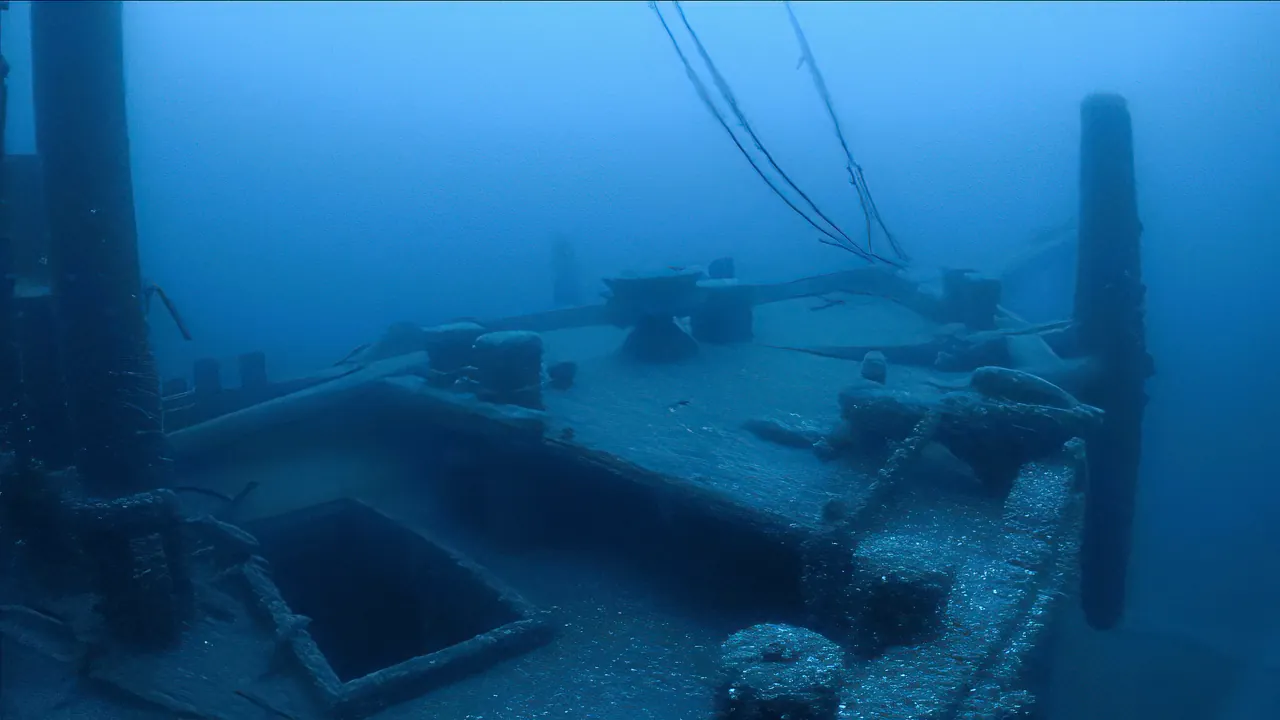
NOAA's Ironton site record identifies the vessel as a schooner barge launched in 1873 and lost in a collision in September 1894. Its photographs show a remarkably preserved wreck, including standing masts and an anchor near the bow. The record also links the site with a broader collection of maritime documents rather than presenting the image as a complete account on its own.
That is an important distinction. The view can help establish what was visible when it was recorded. It cannot independently tell us everything about the crew's experience, the cargo economy, or the sequence that led to the sinking. Those questions require other evidence. The image becomes more valuable when it is connected with a documented vessel and a historical problem, rather than treated only as an eerie object separated from the people and commercial system that once gave it purpose.
A discovery can be a sequence rather than one moment
The NOAA discovery account describes work involving researchers from NOAA, Michigan, Ocean Exploration Trust, and other partners. It distinguishes the mapping work that located the wreck from the remotely operated vehicle observations used to investigate and confirm it. The account also describes more detailed documentation in 2021 before the public announcement in 2023.
This sequence explains why a dramatic headline can compress years of research into the word found. A sensor return may locate a possible target; imagery may then reveal distinctive features; records may support the identification; further investigation may refine the interpretation. None of those stages makes the others unnecessary. When reading a new discovery announcement, ask which stage is being described. The answer can help you understand why researchers sometimes publish a cautious initial statement and a more detailed interpretation later.
Recognize what a photograph leaves outside the frame
A camera records a view from a position, with a particular field of view and lighting. It does not show the whole site equally. A close-up may make a component look isolated when it belongs to a larger arrangement. A wide view may hide details important for identification. Sediment, marine growth, suspended particles, and shadows can obscure features. Even a clear picture requires interpretation rather than automatic acceptance of the first story it suggests.
Try describing the visible evidence without naming a cause. You might write that a mast is standing, a plank appears displaced, or an object lies beside the stern. The next sentence can identify the interpretation and its source. This two-step habit is useful because a damaged part does not necessarily explain how the vessel sank. Damage may precede sinking, result from it, or occur later. A photograph alone may not distinguish those possibilities.
Sonar images are not ordinary underwater photographs
Maritime researchers use instruments that record different kinds of information. Stellwagen Bank National Marine Sanctuary's archaeology overview describes tools including side-scan sonar, remotely operated vehicles, and autonomous underwater vehicles. Sonar uses sound returns to help characterize the seafloor and locate potential sites; optical imagery records light from the view available to a camera. A color palette on a processed image may encode information rather than reproduce the scene as a swimmer would see it.
When a striking view appears in a news story, look for the instrument and the legend. Ask what a bright or dark region represents and whether the image includes scale or orientation. Do not assume that an attractive three-dimensional rendering is a photograph. Different products can complement one another, but confusing them makes it harder to understand both the strength and the limits of the evidence being presented.
A three-dimensional model is a constructed research product
NOAA Ocean Exploration explains photogrammetry as a process that uses overlapping images to approximate three-dimensional structure. Software identifies common features and builds a model, which can then receive visual texture from the photographs. The result can provide a useful record of a site's condition and help people explore features remotely. It remains a product of image capture, processing, and interpretation.
For a viewer, the key questions concern coverage and uncertainty. Which parts were photographed adequately? Does an apparently smooth surface represent observed detail or an interpolated region? Can the model be measured reliably for the question being asked? A model can be excellent for communicating spatial relationships without answering every technical question. Treating it as an aid to inquiry rather than a perfect digital duplicate helps preserve that distinction.
Identification requires comparison with other records
A ship's name may be absent, obscured, or detached from the visible wreck. Researchers can compare dimensions, construction, machinery, cargo evidence, location, and historical accounts. The combination matters more than one familiar-looking feature. An anchor type or a number of masts can narrow possibilities without establishing a unique identity. A persuasive identification explains why the evidence fits one candidate and why plausible alternatives fit less well.
NOAA's maritime archaeology introduction places documentary work alongside remote sensing and site investigation. For a general reader, a useful exercise is to list the independent kinds of evidence mentioned in a report. Are several claims supported by different sources, or does every statement lead back to one old caption? This does not make the reader an archaeologist, but it helps distinguish a reasoned identification from a confident label attached to an appealing image.
Objects gain meaning from their relationships
A loose object can be visually striking, but its location and association with other material may contain much of its historical value. An item beside a hatch, inside a compartment, or within a concentration of cargo can help answer different questions. Moving it can destroy some of that relationship even when the object itself survives. Archaeological recording therefore concerns sites and contexts, not merely a collection of interesting things.
The NOAA maritime heritage methods fact sheet presents archaeology as an interdisciplinary process involving documentation, research, and resource management. The public lesson is straightforward: admiration does not require possession. A well-recorded site can support interpretation through photographs, plans, models, and collections research. This article offers no instructions for approaching, entering, disturbing, or recovering material from a wreck; the emphasis is on understanding evidence that responsible researchers have made available.
Preserved does not mean untouched or permanent
A wreck can retain a recognizable form and still be changing. Different parts may survive differently, and a spectacular image may favor the best-preserved area. NOAA's science and shipwrecks overview explains that environmental conditions influence preservation and that some shallow Great Lakes sites have been affected by waves and ice. Avoid turning a general statement about cold freshwater into a guarantee that every object remains unchanged.
A recorded view is a time-specific observation. Repeated documentation can help researchers assess change, while a single image cannot establish its rate. When sharing a picture, avoid the phrase frozen in time as a literal scientific conclusion. It may communicate the emotional impression of preservation, but it can hide the continuing processes acting on the site. The more precise statement is that particular features were documented in a particular condition when the image was made.
Human stories deserve more care than a haunting caption
A lifeboat or a personal object can make a wreck's human meaning immediate. That emotional response is understandable. It should not become permission to invent a person's last thoughts, assign blame from a photograph, or turn a place associated with death into a puzzle stripped of consequences. Historical accounts may contain testimony, uncertainty, and disagreement that a short caption cannot represent.
For Ironton, the published discovery narrative connects visible evidence with accounts of the loss and the people involved. Read that narrative before supplying a dramatic explanation of your own. Distinguish a reported event from an inference and an inference from an imagined scene. Respectful interpretation can remain compelling without pretending to know what the evidence does not reveal. The discipline is especially useful when an image travels far beyond the researchers and communities who first documented its meaning.
Build a better caption and a better question
A useful shipwreck caption names the vessel or states that identification is uncertain, identifies the image type, provides a date or documentation period, credits the source, and explains the visible feature without exaggeration. A link to the original report lets readers follow the evidence. This is a small contribution, but it can prevent an old photograph from becoming a false new discovery when shared again.
The next question should move beyond whether the image looks amazing. What historical problem does the site help investigate? Which evidence supports the identification? What remains unknown? How is the record being preserved and made accessible? Those questions turn the initial fascination into a more durable interest in maritime history. A powerful image is a doorway into research, not a replacement for it, and learning to recognize that difference makes the doorway far more rewarding.