A harbor full of tall ships offers a wonderfully easy photograph and a surprisingly difficult history lesson. The eye goes first to the highest mast, the broadest spread of canvas, or a flag standing clear against the sky. The less visible subjects matter just as much: who maintains the vessel, what the crew is learning, why this particular ship survives, and whether its appearance represents eighteenth-century warfare, commercial transport, modern education, or several layers of history at once. Those are the questions that remain useful after the parade has passed.
Sail250 belongs in the past tense in this edition. The Coast Guard's July 17, 2026 completion report states that the nationwide tour concluded on July 16, ending in Boston after calls associated with New Orleans, Virginia, Maryland, and New York and New Jersey. This article is a retrospective reading guide, rather than an invitation to attend a future 2026 parade. The distinction matters because old event pages can remain highly visible in search results long after their practical visiting information expires.
A fleet gathering is a collection of different stories
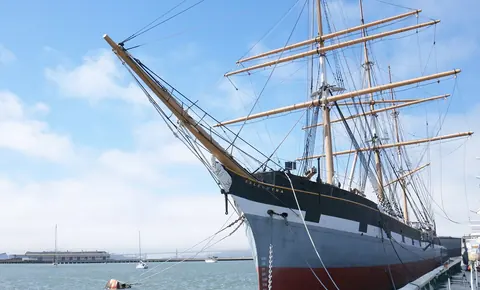
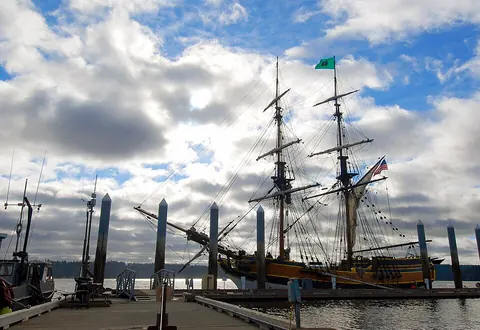
The phrase tall ship describes an impression more readily than it describes one uniform historical category. Two vessels can look closely related from a quay while serving very different purposes. One might be a naval training platform, another a preserved commercial vessel, and another a reconstruction intended to interpret a much earlier design. The most productive first question is therefore a modest one: what is this ship doing now? Answering it prevents a parade from becoming an imaginary fleet whose ships all belong to the same century and share the same job.
The official Sail Boston overview placed the gathering within the 250th anniversary of American independence and identified the participating host ports. That anniversary supplies a reason for the event, not a construction date for every vessel in the harbor. Visitors can preserve the excitement of the occasion while separating the anniversary being celebrated from each ship's individual chronology. A small notebook with columns for vessel name, launch period, present operator, and present purpose turns an attractive waterfront lineup into a much more revealing comparison.
What the post-event numbers can tell us
The Coast Guard's completion report described participation by more than 60 military vessels and tall ships from 20 nations and reported approximately 60,000 visitors aboard Eagle across five ports. These are useful indicators of scale. They should remain attributed to the reporting agency and should not silently become a verified total for every event attendee. A person looking at ships from shore, someone joining a ship tour, and someone returning to another port can all belong to different counting systems. A large number becomes more informative when its unit stays attached.
For a local history project, the practical lesson is to define success before borrowing a headline statistic. If the goal is public learning, the number of questions answered might matter alongside attendance. If the goal is attracting volunteers, a count of people who return for a later work session is different from a count of people who walk past a banner. Our editorial interpretation is that a maritime celebration gains a stronger legacy when organizers can explain which kinds of engagement continued after the closing ceremony. We have not independently measured that legacy for Sail250.
A working ship is more than a moving exhibit
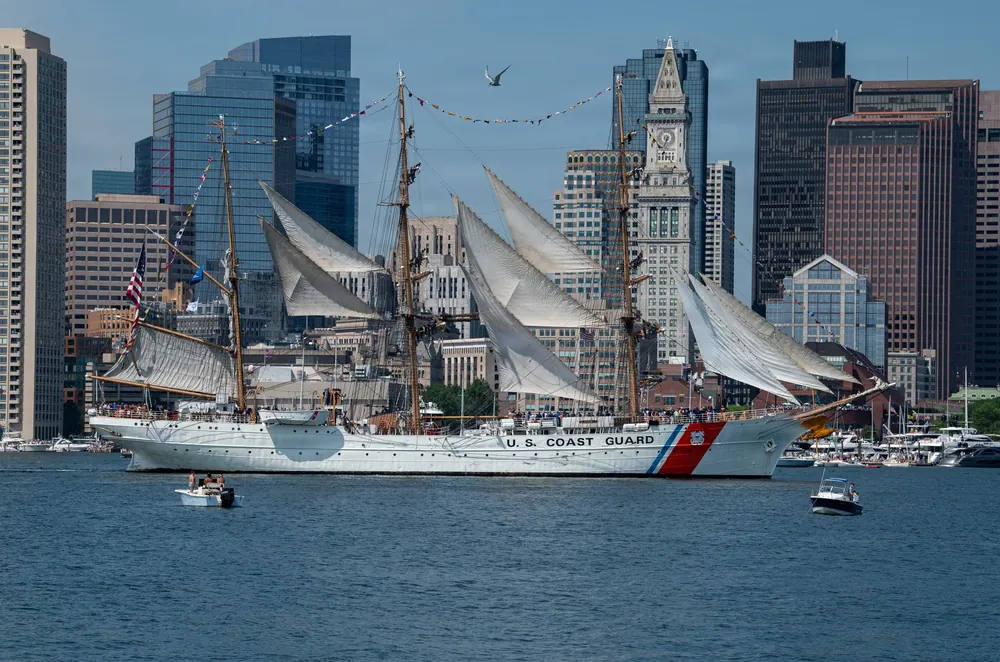
Eagle offers an especially clear example of a ship with an educational role beyond its appearance. The Coast Guard Academy describes its primary mission as training for cadets and officer candidates, including seamanship, navigation, leadership, and teamwork. A parade appearance is one public view of a working institution. It is not the whole explanation for maintaining the vessel. Understanding that distinction changes the questions a visitor might ask: how is responsibility handed between watches, what is taught before a trainee handles a particular task, and how are lessons discussed afterward?
These are observational questions, not claims that this editorial desk sailed aboard Eagle. A visitor can ask them respectfully during an authorized tour, while a reader can compare the Academy's published description with dated photographs and official reporting. The aim is to understand a training system rather than to judge a crew from a few minutes at the rail. A quiet deck alongside may be between activities. A dramatic image may capture a demonstration. Neither moment supplies a complete account of the ship's working day or the learning of each person on board.
Look at the vessel before reaching for a historical label
Begin with features that can actually be seen. Count the masts, note the direction in which the principal yards lie, and look for the relationship between sails and the ship's centerline. Record what is visible rather than filling gaps from a familiar movie. If sails are furled or a mast is obscured by another ship, mark that limitation. This habit makes subsequent identification more accurate because the reader has a record of the evidence used, rather than only a confident name attached to an uncertain photograph.
The same method helps distinguish the ship's structure from temporary decoration. Flags can be arranged for a celebration; bunting does not identify a working sail plan. A yard can be visible without its sail being set. A ship may be moving with assistance that falls outside the photograph. The educational value lies in learning to ask what an image establishes and what it leaves unknown. That is a transferable historical skill: the person who notices the edge of a maritime photograph is already learning how to read other kinds of evidence carefully.
The image caption is part of the evidence
The hero photograph for this article comes from a dated Coast Guard image record identifying Eagle in Boston Harbor on July 11, 2026, with a named photographer. This information is more useful than a repost labeled only amazing old ship. A sound caption lets a reader reconnect the image with a place, date, and institutional record. It also prevents a recent photograph from being mistaken for a scene from an earlier anniversary or a different port.
Build a personal collection around that standard. Save the original source page alongside an image link; write down whether a caption identifies the vessel or merely describes a scene. If you later crop the picture for a classroom presentation, preserve the attribution and note that the framing changed. Cropping can improve legibility while removing contextual clues, such as a tug, dock, or neighboring vessel. Transparent handling of that small editorial choice is an accessible way to teach how public history is made and why picture provenance matters.
Independence and naval history follow different timelines
A national anniversary can compress many historical developments into one attractive visual story. It helps to slow that story down. Independence, the organization of early American maritime forces, later naval construction, and modern heritage preservation do not share a single start date. One ship can illuminate a later consequence of the Revolutionary era without having taken part in the Revolution itself. Treating chronology as a sequence of decisions makes the ships more interesting, because their different designs and purposes become evidence of change rather than imperfections in a commemorative tableau.
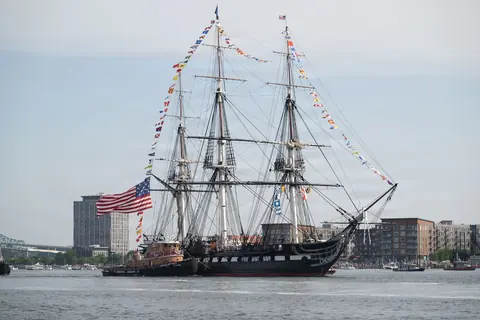
For example, the National Park Service identifies Constitution as launched in 1797 and as one of the original frigates of the United States Navy in the 1790s. That makes the ship a powerful way to discuss the republic's later naval development. It does not make her a surviving ship from the Continental Navy's founding moment. The comparison is valuable precisely because the dates differ. A reader who makes room for those differences can connect celebration with historical inquiry instead of asking a single emblem to represent every stage of the national story.
The harbor itself deserves attention
Ships draw the camera, yet a harbor is also a working arrangement of piers, channels, service craft, access routes, and people whose jobs continue while visitors arrive. Consider an ordinary shore-based observation exercise: sketch where the public route meets the working waterfront, then mark where movement is restricted. The sketch need not identify security arrangements or enter controlled areas. Its purpose is to show that a waterfront is organized space. A parade does not take place on an empty blue background; it shares an environment with transport, employment, maintenance, and everyday movement.
That perspective encourages better questions about a historic ship's permanent home. Is there space for upkeep as well as display? Can educational groups gather without obstructing other users? How does the setting help explain the vessel? These are questions a visitor can bring to a museum or community discussion without claiming expertise in port operations. They also make heritage less dependent on a single spectacular arrival. The less dramatic infrastructure around a ship often determines whether it can remain accessible and well interpreted after attention moves elsewhere.
A useful legacy is something people can do next
The Sail4th 250 retrospective records the July 4, 2026 celebration and presents the gathering as part of an ongoing maritime tradition. For a reader, that provides a natural point to move from spectacle to a manageable next step. Choose one vessel and read its operator's history. Choose one unfamiliar rig and draw its principal arrangement. Choose one source used in a caption and trace it back to the original record. None of those activities requires an imagined membership in the crew or an expensive new commitment.
A classroom can make this more concrete by comparing two ship biographies and asking what each one leaves out. One may foreground technical dimensions, another voyages, another preservation. Students can propose a missing paragraph and explain which evidence they would need before writing it. A community group can use the same approach to prepare better questions for an invited speaker. The important shift is from collecting impressive facts to identifying answerable questions. Learning continues when the reader knows what to investigate next and can tell the difference between an answer and an assumption.
Keep project ambition separate from an operating fleet
Interest generated by a parade can easily spill into searches for reproductions, future voyages, and historical ship projects. Read those pages with attention to verbs. Plans to build, hopes to operate, historical designs, and confirmed public access describe different states. The Colonial Navy material preserved on this website includes project ambitions and historical vessel studies. This article does not establish that a proposed reproduction has been completed, certified, staffed, or placed into current service. A photograph of a model or a related historic ship cannot settle those operational questions.
The distinction protects both the reader and the historical subject. A design can deserve serious study even when the proposed vessel has not been built. A preservation ambition can be meaningful without being a ticket offer. Ask for current, dated confirmation from the responsible operator before treating a page as evidence of present access or availability. For ordinary reading, enjoy the drawings and historical comparisons for what they demonstrate. For practical plans, require information that addresses the exact activity being contemplated, rather than borrowing certainty from the romance of the image.
After the parade, keep the better questions
Sail250's photographs will continue to circulate because ships under tall masts make a strong visual argument for paying attention to the sea. The lasting opportunity is to make that attention more precise. A visitor can move from recognizing a silhouette to understanding a vessel's role, from repeating a visitor total to examining what was counted, and from admiring an old-looking ship to asking which parts of its history are being interpreted. Those changes are small enough for a beginner and substantial enough to support a much deeper interest.
The event's public record tells us that the gathering happened and gives us a starting set of dates, places, images, and institutional perspectives. It does not tell us everything a visitor learned or everything the ships mean. That remaining space is where thoughtful public history begins. Keep the photograph, keep its caption, and then keep one well-framed question beside it. A tall ship becomes more than a moment of spectacle when the person looking at it gains a reliable way to continue learning after the harbor returns to its ordinary work.