A ship on screen can become familiar before a viewer knows its real name. A sweep of the camera catches the bow, the masts and the lines overhead; the story supplies a fictional world to explain them. Lady Washington is a particularly interesting example because the vessel has a documented identity outside that fictional world. She is also an educational and heritage project, built and maintained by people whose work continues when the camera stops recording.
The important starting point is to distinguish three things: the original historical vessel, the modern replica and a character played by that replica in a production. They are connected, but they are not interchangeable. Keeping them separate makes the screen connection more interesting, because it reveals how a real ship can carry different kinds of stories without turning a film into historical evidence. It also gives fans a way to move from recognition to a more serious interest in maritime history.
The ship you can photograph is a modern construction
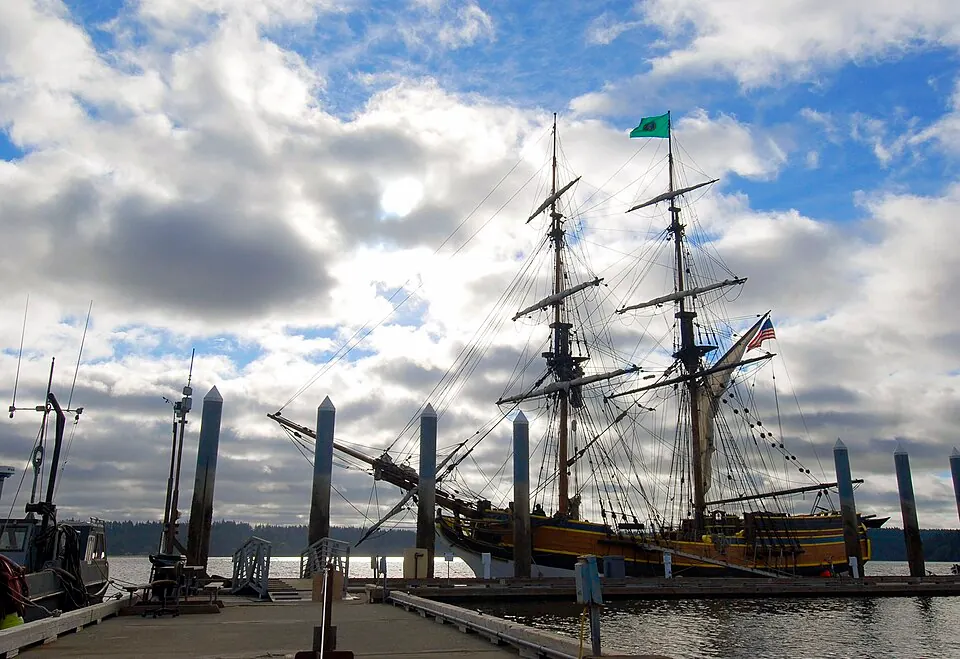
Grays Harbor Historical Seaport dates the modern Lady Washington’s launch to March 7, 1989, in Aberdeen, Washington. The operator describes her as a full-scale replica and identifies her modern rig as a brig. Its history also lists appearances in Pirates of the Caribbean: The Curse of the Black Pearl, Star Trek: Generations, Once Upon a Time and Revolution. Those are documented connections; they do not require speculation about which uncredited shot or background vessel a viewer might have recognized elsewhere.
A replica is not an original ship that has somehow avoided change for two centuries. It is a later construction informed by research and a set of choices. The distinction does not make it less useful. It changes the questions worth asking. Instead of asking whether every piece of wood comes from the eighteenth century, ask what evidence informed the design, which historical period is being interpreted and how the modern vessel must meet the demands of operation, education and maintenance.
The earlier vessel belongs to a different story
The original Lady Washington appears in the history of Pacific trade, exploration and cross-cultural contact. That is a much broader subject than an adventure-film setting. The Dictionary of Canadian Biography’s account of John Kendrick describes an exchange of commands with Robert Gray in 1789 and Kendrick’s subsequent trading aboard Lady Washington. Even a short reference like this shows why a single heroic image cannot explain an entire career: command, purpose and location changed over time.
Readers should be cautious with first-to-arrive claims. Such phrases usually depend on a carefully defined flag, nationality, destination or voyage, and can hide the fact that Indigenous communities already lived, navigated and traded in the places described. A ship’s arrival was a new event within existing societies, not the beginning of those societies’ histories. A useful maritime interpretation can acknowledge the reach of a voyage while still asking whose records survive and whose perspective an older account leaves largely unrecorded.
What a film appearance proves—and what it does not
A documented screen appearance establishes that a production used a vessel. It does not establish that the fictional ship has the replica’s historical dimensions, name or career. Films can combine exterior footage, studio sets, sound, edited movement and visual effects into an apparently continuous space. This is ordinary storytelling technique. It becomes a historical problem only when viewers treat the resulting fiction as an unmediated record of how a particular earlier ship was built or operated.
A useful exercise for a fan is to watch a scene twice with different questions. On the first viewing, follow the story. On the second, identify only features you can actually see: a mast, a yard, a deck opening, a boat or a piece of equipment. Then compare those observations with a dated photograph of the real vessel. Leave uncertain identifications uncertain. This method respects the pleasure of the film while introducing the same distinction between observation and interpretation that a museum researcher needs.
A brig gives the story a physical structure
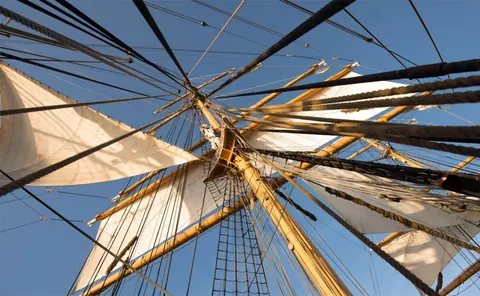
The modern Lady Washington’s two-masted square-rigged arrangement is central to the way she looks and functions. The rig is not simply a background decoration added to produce an atmosphere. It organizes the work of handling canvas and connects activity on deck with equipment above it. Looking at the whole arrangement helps explain why a tall ship reads so powerfully on camera: human figures move within a structure large enough to reveal scale, coordination and exposure in the same frame.
That visual power should not be confused with effortless operation. A sequence edited into a few seconds may represent work that requires preparation, communication and supervision. A visitor can learn more by asking how the crew prepares for a maneuver than by asking whether the filmed version looked realistic enough. The question directs attention toward real practice without requiring the visitor to become a sailor. It also leaves room for the crew to explain what is appropriate for a public program rather than a film set.
Education is a different kind of performance
The operator’s educational description presents Voyage of Explorers as a program using learning stations and activities such as handling lines and setting or dousing sails under the crew’s direction. The educational value is not that a student has temporarily become an eighteenth-century mariner. It is that a real environment can make questions about force, coordination, trade and evidence concrete. A rope, block or sail provides a physical starting point for an explanation that might otherwise remain abstract.
Teachers can prepare for that kind of learning by choosing a small number of questions before a visit. One group might trace how information moves from an instruction to coordinated action. Another might compare the names of deck spaces with their apparent purpose. A third could examine the difference between a current photograph and a historical illustration. These are suggested activities, not a claim that every program offers them. The operator should confirm what is available for the specific age group, location and season.
Preservation continues outside public view
A working wooden vessel needs sustained care, including work that produces no dramatic photograph. Inspection, preparation, repair, documentation and storage can be as important to a heritage project as an open deck or a sail through a harbor. The Historical Seaport’s website directs readers to restoration information. It contains material associated with different seasons, which is precisely why an older trip advertisement should not be treated as a guarantee that a particular sail is operating now.
The Washington State Historical Society’s 2025–2027 capital request describes a Lady Washington restoration project involving systems and fabric such as wiring, hull wood, spars and rigging. A project description identifies proposed work; it does not establish that every item has been completed. That difference is easy to miss in a search result. Readers evaluating a current visit should look for a dated update from the operator rather than inferring operational readiness from the existence of a grant or a restoration photograph.
What makes a replica historically useful
The strongest question is not whether a replica is perfectly authentic in every possible sense. No single test can settle that. Instead, ask what it is intended to explain and how honestly it communicates its construction and limitations. A vessel may be especially effective at showing the relationship between a rig and the work of a crew, while a museum display may be better suited to presenting a rare original object. These are complementary forms of interpretation rather than competitors in a contest for historical purity.
For an interested visitor, a useful checklist includes the evidence used in the reconstruction, the date and purpose represented, major modern accommodations, and where uncertainty remains. Answers need not be elaborate to be informative. Even a clear distinction between documented features and informed reconstruction can improve a visit enormously. It teaches readers that historical knowledge is assembled from evidence and explained choices, rather than arriving as a complete and unquestionable picture.
The people beyond the captain’s name
A ship’s public identity often gathers around one captain, designer or screen role. Its continuing life depends on a wider set of work: shipwrights, riggers, crew, educators, administrators, volunteers and supporters. Recognizing those roles does not require invented anecdotes about particular individuals. It requires asking what tasks a functioning heritage vessel needs and following the organization’s own accounts where available. That approach makes maritime history less dependent on a single celebrity and more attentive to the skills that preserve it.
The U.S. Navy photograph accompanying this article records the modern ship at Brownsville, Washington, on August 28, 2008. Its date and credit matter. The image provides evidence of a particular vessel at a particular moment, not a view of her current condition. Photograph captions are small but important tools for keeping a heritage story accurate, especially when an attractive image is reused many years after the shutter was released.
Use screen recognition as the beginning
If a familiar film brings you to Lady Washington, let the recognition open a second set of questions. Which ship is this? When was she built? Who operates her? Which earlier history does she interpret? What is being maintained now? Those questions lead toward sources that can be checked, unlike the broad feeling that every traditional vessel belongs to the same romantic past. They also give a visitor a clearer sense of what can be learned aboard a modern heritage ship.
A family activity can extend the connection beyond the visit. Make three columns headed historical evidence, modern vessel and screen story. Put each new fact in the column it belongs to, and write the source beside it. A launch date belongs to the modern vessel; a trading voyage belongs to the original history; a fictional captain belongs to the production. If an item seems to span columns, explain the connection instead of copying it into all three. The resulting page becomes a small, checkable research record rather than a collection of attractive but mixed-up memories.
Before planning a visit, use the operator’s current information and confirm the specific program rather than relying on this historical overview. Before repeating a screen claim, compare it with the operator’s documented credits. And before describing the modern vessel as an eighteenth-century survivor, remember the launch date. None of these habits takes away the fascination. They make it possible to enjoy the film, appreciate the reconstructed ship and investigate the original vessel as three distinct, connected stories.